EU AI Act Compliance and Why Trusted Text-to-Speech Matters Now More than Ever
By Andrea Cavalieri, Senior Principal Product Manager
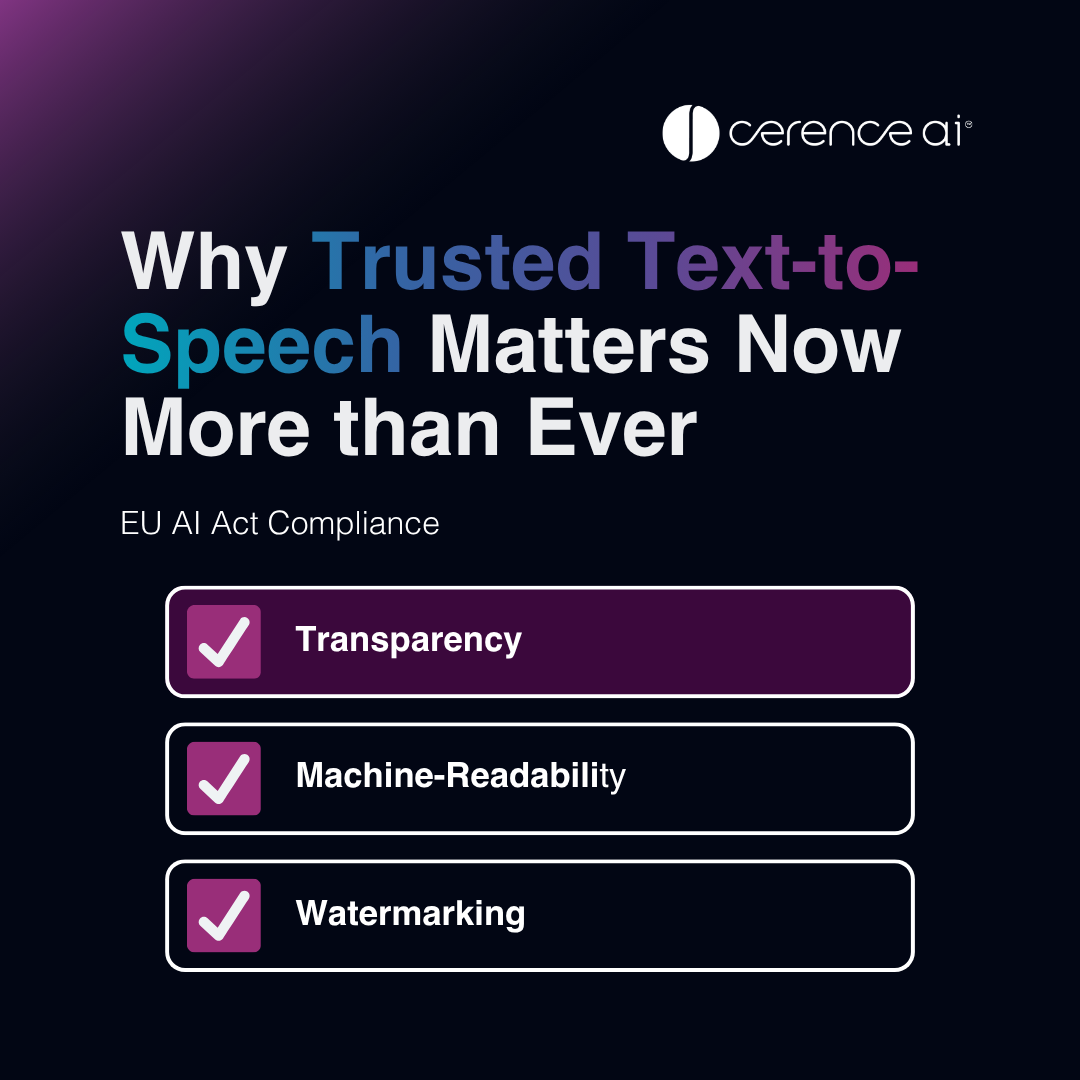
High‑quality, realistic, and expressive synthetic voices are now core interface layers across assistants, applications, services, and devices. Text‑to‑Speech (TTS) underpins conversational AI, accessibility solutions, customer interaction channels, and generative AI experiences.
At the same time, trust in AI‑generated content has become a regulatory and societal priority. The EU Artificial Intelligence Act (EU AI Act) is one of the first legal frameworks to explicitly address this need.
As AI systems become more capable, and more embedded into everyday interactions, ensuring that people can understand, verify, and trust AI-generated outputs is becoming just as important as performance.
This is especially true for voice. Synthetic speech carries an inherent sense of authenticity, which makes responsible design and transparency mechanisms critical. With deepfakes and other misuse on the rise, trustable, signed TTS is foundational to future applications of this technology.
For Cerence AI, the EU AI Act is not just another compliance topic, but rather an opportunity to strengthen our product with transparency and verification at the center of our offering, setting clear trust guardrails for the AI-generated voice interfaces changing how we interact with technology.
The EU AI Act Introduces Transparency Requirements for Synthetic Audio
Article 50(2) of the EU AI Act introduces transparency requirements for systems generating synthetic audio. AI‑generated speech must be machine‑readable, marked, and detectable as synthetic. These obligations are currently expected to apply from August 2, 2026, subject to potential legislative updates.
For organizations that deploy TTS across cloud services, embedded environments, or hybrid architectures, this represents an important shift: TTS voice output is no longer just an output modality; it is a traceable and accountable AI artifact.
EU AI Act: It’s not just About Compliance
While much discussion around the EU AI Act focuses on regulatory readiness, the underlying technical measures serve a broader purpose. Machine‑readable metadata, digital audio watermarking, and similar mechanisms help distinguish authentic AI‑generated speech from manipulated or falsified audio. With increasingly realistic voice generation becoming widely accessible, this distinction is critical to sustaining trust at scale.
From a product perspective, transparency is therefore not a constraint but an enabler supporting responsible deployment, risk mitigation, and long‑term customer confidence.
Cerence TTS: Path to Article 50(2) Alignment
Trust is our North Star, and rather than waiting for final enforcement milestones, we have already designed and delivered a compliant Cerence AI TTS product. At the same time, we’re proactively supporting our customers to help them align with the evolving Code of Practice.
In respect to Article 50(2), Cerence AI developed a TTS solution that incorporates built-in capabilities aligned with current EU guidance and the emerging transparency Code of Practice for AI-generated content.
Depending on deployment configuration, this includes a multi-layer technical transparency approach, for example:
Machine-readable metadata indicating synthetic speech
Digital audio watermarking
These capabilities are designed to operate consistently across both cloud‑based and embedded TTS environments.
Supporting Customers Ahead of the Applicability Timeline
Obligations under Article 50(2) are expected to apply beginning on August 2, 2026, though the timeline may change due to legislative updates. Still, early preparation is essential to avoid last-minute scrambles ahead of deployment deadlines.
While the EU AI Act established the legal framework, the Code of Practice helps to define how implementation expectations will evolve.
Cerence AI’s approach is therefore to align TTS EU AI Act compliance capabilities with the direction of the Code of Practice today, and to continue updating implementations as the guidance evolves. This ensures customers can move forward with confidence amid ongoing regulatory interpretation.
Disclaimer: This post is for informational purposes only. Cerence disclaims all warranties and liability. Customers remain solely responsible for their own legal and regulatory assessments.


.png)