How a Multimodal AI Foundation Helps OEMs Build More Context-Aware Vehicle Experiences
By Nicholas Phillips, Principal Product Manager
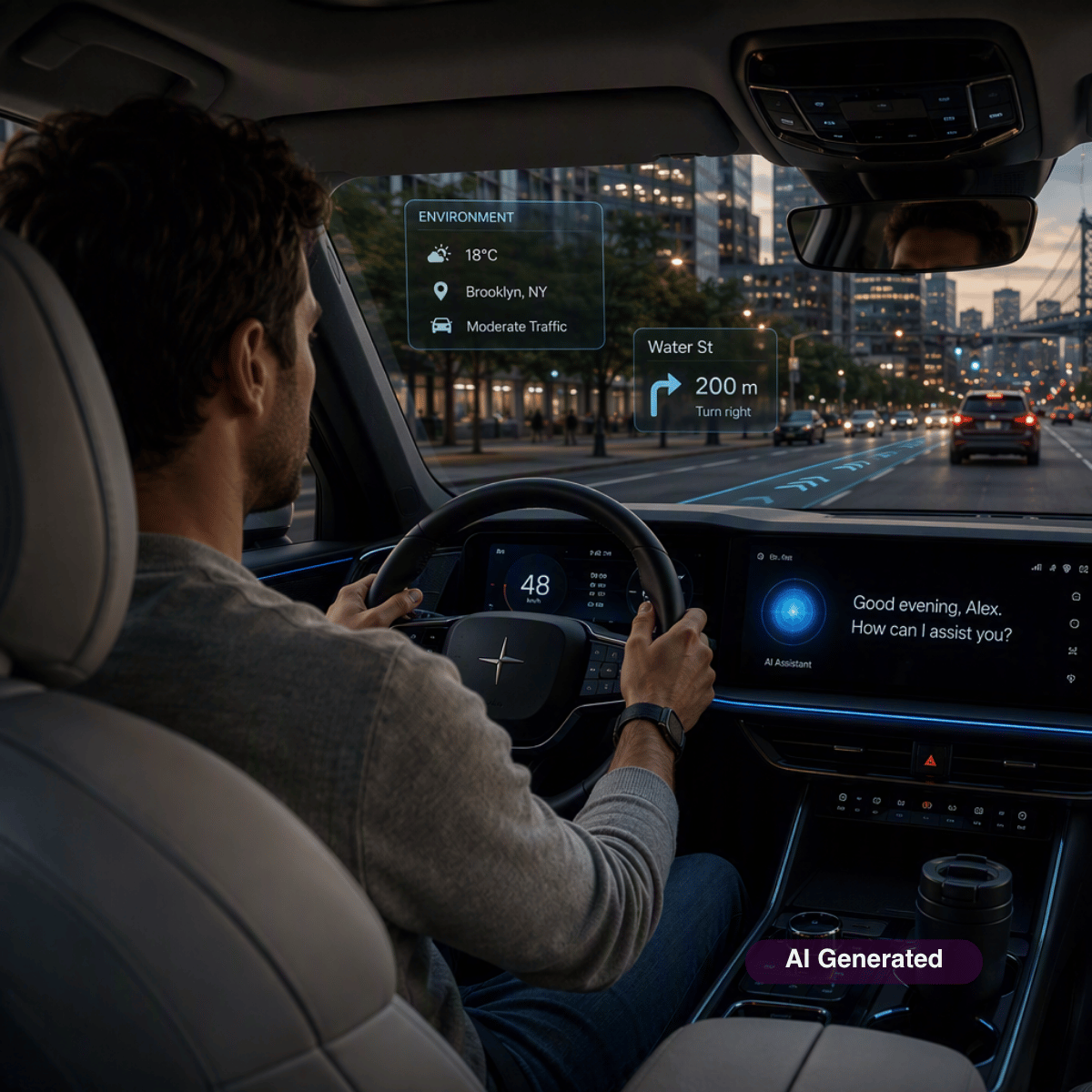
Automakers are increasingly expected to deliver in-vehicle assistants that use speech, visual signals, vehicle data, and the surrounding environment to understand user intent. Meeting that expectation requires an architecture designed for multimodal reasoning.
For OEMs, that architectural decision has implications well beyond a single feature or model generation. A multimodal foundation can support more intuitive interactions, simplify the path to global deployment, and make it easier to incorporate advances in AI into the user experience.
Cerence xUI®, our hybrid automotive AI platform, brings these inputs into a shared reasoning process to create a richer understanding of driver intent, allowing OEMs to deliver better experiences today while establishing an AI architecture that can evolve throughout the vehicle lifecycle.
With Cerence xUI, audio and vision are not treated as separate capabilities operating independently of one another. Instead, they contribute to a shared understanding of the driver's request.
As AI models continue to advance, this architectural foundation allows new capabilities to be incorporated into the experience while maintaining a consistent automotive-grade platform.
Here’s why this matters.
Reasoning Beyond a Transcript
A transcript captures vocabulary, not delivery.
Cerence xUI reasons using the full audio signal, helping account for factors such as tone, urgency, hesitation, accents, dialects, and multilingual speech.
Consider a driver saying, "Not this song again." The transcript remains the same regardless of whether the comment is delivered with amusement, frustration, or sarcasm. Yet the intent may differ.
Using richer audio signals as context creates the opportunity for assistants to respond more naturally, helping reduce the need for drivers to memorize exact command structures.
This approach can reduce dependence on fully separate transcription pipelines for every language market, creating a path for more markets to share a common architecture as audio-native models improve.
For OEMs, that also creates a path to adopt advances in speech and audio reasoning without redesigning the entire in-car experience around every new model generation.
Bringing the Cabin into the Conversation
Many in-vehicle interactions depend on visual context.
Take, for example, a tire-pressure warning appearing during a highway trip. Rather than searching through the owner's manual or trying to describe an unfamiliar symbol, the driver simply asks, "It looks like something is wrong. Do I need to stop?"
The words alone provide only part of the picture.
xUI brings supported cabin, display, and vehicle signals into the same reasoning process as speech. Rather than forcing drivers to translate what they see into precise language, the system uses available context to better understand the request, reducing friction and making the experience feel more natural.
Extending Context Beyond the Cabin
The same principle applies outside the vehicle.
A driver passes an unfamiliar landmark and asks, "What is that building?" A construction sign flashes past too quickly to read. The driver asks what it said.
In each scenario, visual context from the surrounding environment helps ground the interaction. The assistant can use what the vehicle perceives, along with relevant contextual information, to provide a more useful response.
What Changes for OEMs
A multimodal foundation has important implications.
Reduced Interaction Burden
Drivers can communicate more naturally when they don't have to reformulate every request into machine-friendly language. In a vehicle, reducing that friction can help keep attention focused on driving.
A Simpler Path to Global Deployment
Models that can reason over richer audio signals handle accents, dialects, and multilingual interactions more naturally than systems built around rigid language-specific pipelines.
Localization, validation, and market-specific optimization remain essential. At the same time, more of the underlying architecture can be shared across regions.
A Foundation for Future AI Experiences
Many emerging AI capabilities depend on understanding context.
Personalization, proactive assistance, and agentic experiences all benefit from a broader understanding of what a driver is doing, seeing, and requesting. A transcript alone provides only part of that picture.
Why OEM Decisions Matter Now
The voice architecture selected for a vehicle today will serve drivers through multiple generations of AI advancements. Much of its useful life will be spent in a market shaped by capabilities that may not yet exist.
OEMs need a foundation that can evolve alongside advances in audio, vision, reasoning, and agentic AI. Cerence xUI is designed to provide that foundation, allowing newer models and capabilities to be incorporated as they mature and become ready for automotive deployment.
The objective is straightforward: create an experience that can continue improving throughout the vehicle lifecycle rather than being constrained by the capabilities available on day one.
Designing for the Way People Communicate
Audio, vision, vehicle data, cabin context, and environmental context all contribute to a shared understanding of intent, allowing drivers to spend less effort translating requests into rigid commands, while giving vehicles access to a fuller picture of what those requests actually mean.
For OEMs, that creates an opportunity to deliver experiences that feel more intuitive today while establishing the foundation for the next generation of AI-powered interactions tomorrow.
The industry is moving beyond voice interfaces that only process words. The next chapter is about understanding context. Cerence xUI is built for that future.

.png)