More Than Just Words: How a Multimodal AI Foundation Helps OEMs Build More Context-Aware Vehicle Experiences
By Nicholas Phillips, Principal Product Manager
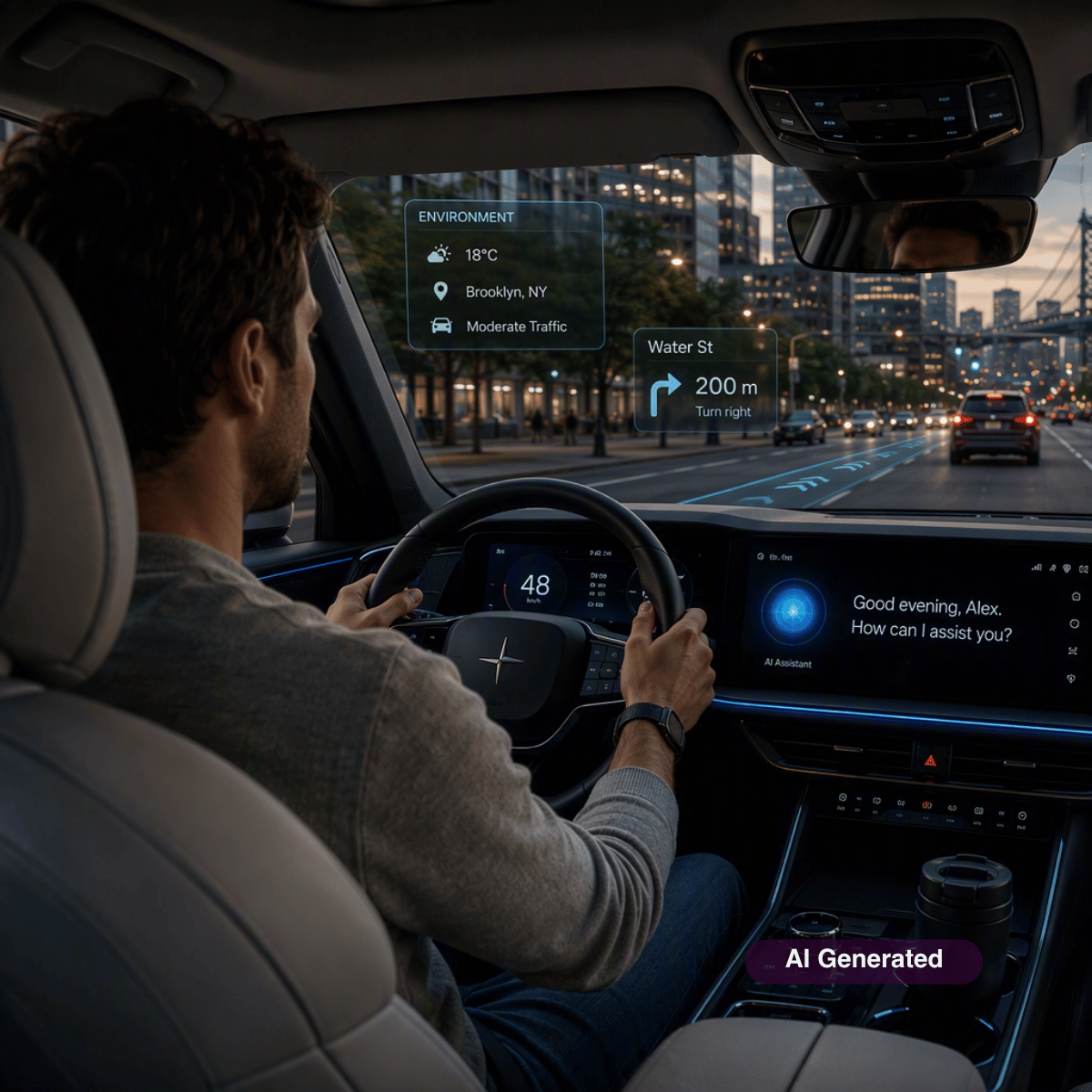
OEMs are increasingly expected to deliver in-vehicle assistants that use speech, visual signals, vehicle data, and the surrounding environment to understand what a driver means. Drivers’ expectations have changed faster than the cars they drive and meeting them takes an architecture designed for multimodal reasoning.
For OEMs, that decision reaches well beyond a single feature or model generation. A multimodal foundation supports more intuitive interactions, simplifies global rollout, and makes it easier to fold in advances in AI as they arrive.
Cerence xUI®, our hybrid automotive AI platform, is built to bring those inputs into one reasoning process instead of handling them separately. OEMs get a better experience today and an architecture that keeps improving over the life of the vehicle.
Multimodality Starts with the Architecture
In xUI, audio and vision aren’t features bolted on after the fact. They feed the same reasoning which determines what the driver is asking for.
As models improve, new capabilities can be added to the experience while the platform underneath stays automotive grade.
Reasoning Beyond a Transcript
A transcript captures vocabulary, not delivery.
xUI is built for models that reason over the full audio signal: tone, urgency, hesitation, accent, dialect, and shifts between languages.
Consider a driver saying, "Not this song again." The transcript is the same whether it’s said with amusement, frustration, or sarcasm. The intent isn’t. The assistant is built to hear the difference and skip the track instead of waiting for a literal "next."
This can also reduce dependence on a separate transcription pipeline for every language market, so more markets can share one architecture as audio-native models improve.
For OEMs, that means adopting advances in speech and audio reasoning without rebuilding the in-car experience around every model generation.
Bringing the Cabin into the Conversation
Much of what people say in a car refers to something they can see.
A list of charging stations is on the display. The driver asks, "how long to that one?" Nothing in those words identifies a station. The screen does.
xUI is built to bring display state, cabin signals, and vehicle data into the same reasoning process as speech, so a request like that resolves to the station the driver means. Without it, the driver reads the name off the screen and says it exactly, or takes a hand off the wheel to tap it.
Extending Context Beyond the Cabin
The same reasoning extends past the windshield.
A construction sign flashes past before the driver can read it. "What did that sign say?" The assistant answers: right lane closed after exit 14. No map database holds that. The sign went up this morning and may be gone next week, and the only record of it is what the vehicle saw.
The architecture extends outward to exterior signals, so the assistant can answer based on what the car saw rather than from what a database knows about that stretch of road.
What Changes for OEMs
For OEMs evaluating in-car voice, three things change when multimodality is architectural instead of additive.
Less Translating for the Driver - When drivers don’t have to convert what they mean into machine-friendly commands, less attention leaves the road. Less time fighting the interface, more time with hands on the wheel and eyes ahead.
Simpler Global Rollouts - Models that reason over the full audio signal handle accents, dialects, and multilingual speakers more gracefully than systems built around rigid language-specific pipelines. Markets that used to need separate pipelines start to look like one problem instead of dozens.
Localization, validation, and market-specific tuning don’t go away, but more of the architecture underneath can be shared.Ready for What Comes Next - Personalization, proactive assistance, and agents all depend on knowing what the driver is doing, seeing, and asking for. A system still working from a transcript can’t ground an agent in the cabin and the road.
Why OEM Decisions Matter Now
The voice architecture chosen for a vehicle today will serve drivers through several generations of AI. Most of its life will be spent in a market shaped by capabilities that don’t exist yet at launch.
OEMs need a foundation that can evolve alongside advances in audio, vision, reasoning, and agentic AI. Cerence xUI is designed to provide that foundation, allowing newer models and capabilities to be incorporated as they mature and become ready for automotive deployment.
The goal is an experience that keeps improving over the vehicle’s life instead of being fixed at the capabilities of day one.
Designing for the Way People Communicate
Audio, vision, the cabin, and the road are all part of the same conversation from the start. Drivers stop translating their intent into machine-friendly commands. The vehicle finally has what it needs to speak the same language they do.
For OEMs, that’s a better experience now and the perception foundation the next generation of agents will need.
Voice interfaces that only process words are running out of room. xUI is built for what comes after, and that conversation can start today.