The AI Transformation Hitting Dealership Row
By Sai Yagnyamurthy, GM, Growth & Strategic Verticals
.png)
Part 1 — Why Now, and Why It Hurts to Wait
This is Part 1 of a multi-part series on how AI is reshaping automotive dealerships across sales, service, repairs, and overall customer engagement. In this installment, we look at the pain points driving dealerships to act, and the shape of the transformation already underway. Later, we will dig into specific use cases, implementation lessons, and what customers want from AI-powered experiences.
The Operational Crisis Hiding in Plain Sight
Walk into almost any dealership's service department today and you'll see the same story playing out: advisors juggling three phone lines, sales teams bouncing between new inquiries, follow-ups, and walk-ins, and a general manager quietly worried about next quarter's labor line. The automotive industry isn't short on demand; vehicles are more complex, more connected, staying on the road longer than ever, and delivering constant real-time vehicle health data. The gap is operational: disconnected systems, limited staffing, and service and sales inquiries that go unanswered after hours, leaving revenue and customer opportunities on the table.
That's why AI has moved from an interesting experiment to a business imperative. It's already reshaping how dealerships, retail operations, and repair shops compete for customers and margin. And the dealerships that treat AI as a bolt-on chatbot are going to find themselves out-executed by competitors treating it as core infrastructure.
At Cerence AI, we are already helping dealerships address these challenges through our Dealer Assist Agent (DAA), an AI-powered solution that supports sales and service interactions around the clock. Grounded in each dealership’s specific data, inventory, services, policies, systems, and workflows, it can respond to customer inquiries, schedule service, and connect customers with the right dealership resources. Our work implementing these capabilities gives us a firsthand view of where dealerships are feeling the greatest pressure and where AI can deliver meaningful operational and customer experience improvements.
The Pain Points Leadership Actually Feels
Talk to enough dealer principals, service directors, and fixed-ops managers, and the same four pressures come up again and again:
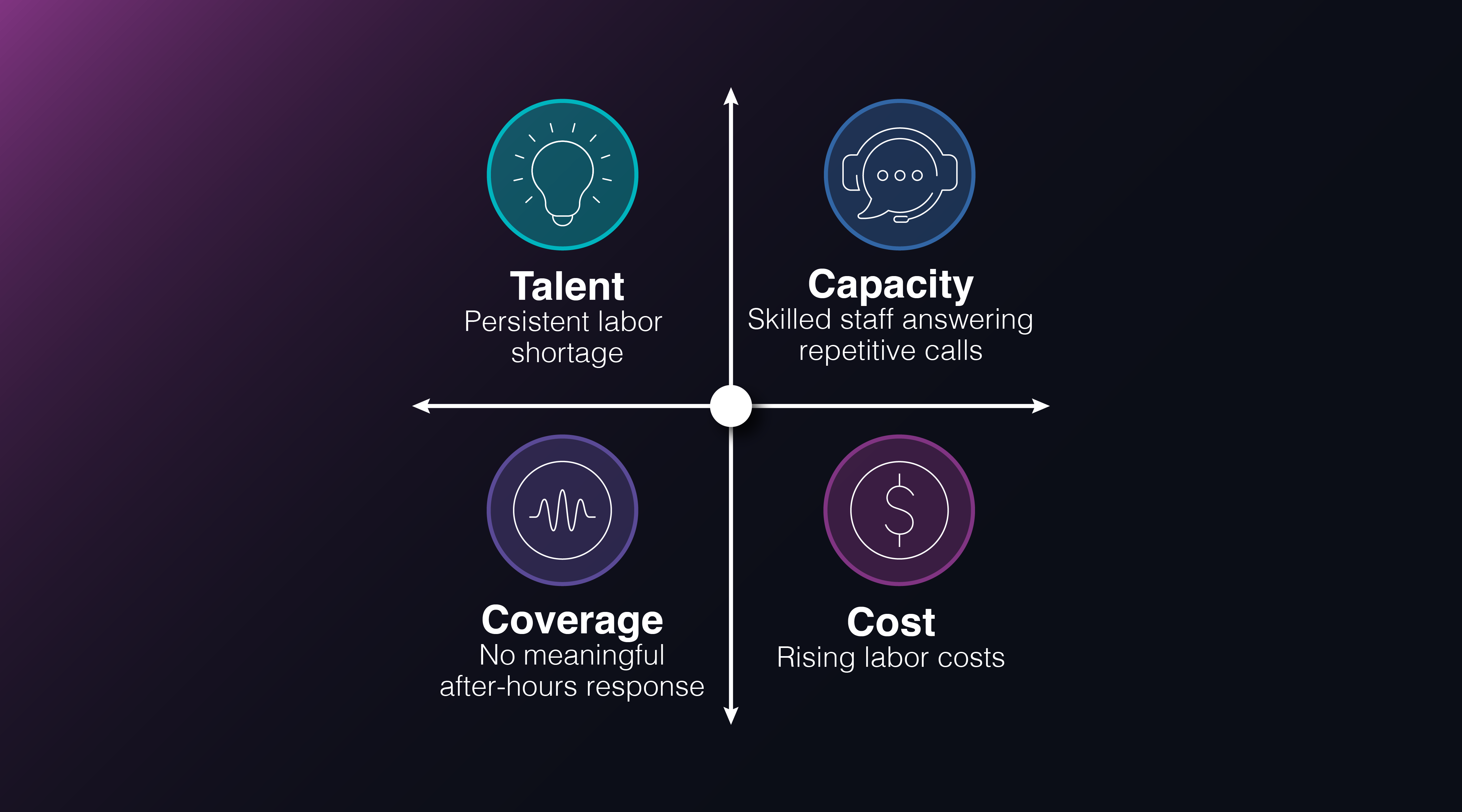
Four Pain Points Reshaping Dealership Operations
A Persistent Labor Shortage: Technicians, service advisors, and business development center (BDC) staff are hard to hire and harder to keep. Turnover in service departments remains high, and the pipeline of new technicians hasn't kept pace with the complexity of modern vehicles.
Too Much Labor Tied Up Answering Phones: This is the pain point that surprises people the most once they look at the data. A huge share of advisor and BDC time isn't spent advising or selling. It's spent on the phone answering the same handful of questions: “Are you open?” “Do you have this part?” “Can I get an oil change today?” “What's my car's status?” That's expensive, repetitive labor that could be automated, freeing skilled staff to do the higher-value work only humans can do.
Individually, each of these is a known headache. Together, they compound into something structural: dealerships are leaving revenue on the table not because demand is missing, but because the operation can't capture and serve it fast enough.
Rising Labor Costs: Even when dealerships can hire, wage pressure keeps building. Every additional advisor or phone-bank hire is a fixed cost that has to be justified against thinning margins on new vehicle sales, which pushes more dealerships to lean on fixed ops for profitability, precisely the department most strained by staffing.
No Real After-Hours Coverage: Service and sales inquiries don't stop at 6:00 p.m. Customers get a flat tire at 9:00 p.m., remember they need an oil change while lying in bed after a hard day’s work, or want to browse inventory on a Sunday. Most dealerships have no meaningful way to capture that demand. It either goes to voicemail, gets picked up the next business day by the first dealer that makes the call, or the customer simply calls a competitor down the street.
What AI Actually Changes
The promise of AI in dealerships isn't a simple chatbot on the website. It's the ability to connect and optimize the whole ecosystem around vehicle sales, service, parts, and customer relationships, in ways that were previously too labor-intensive to do consistently.
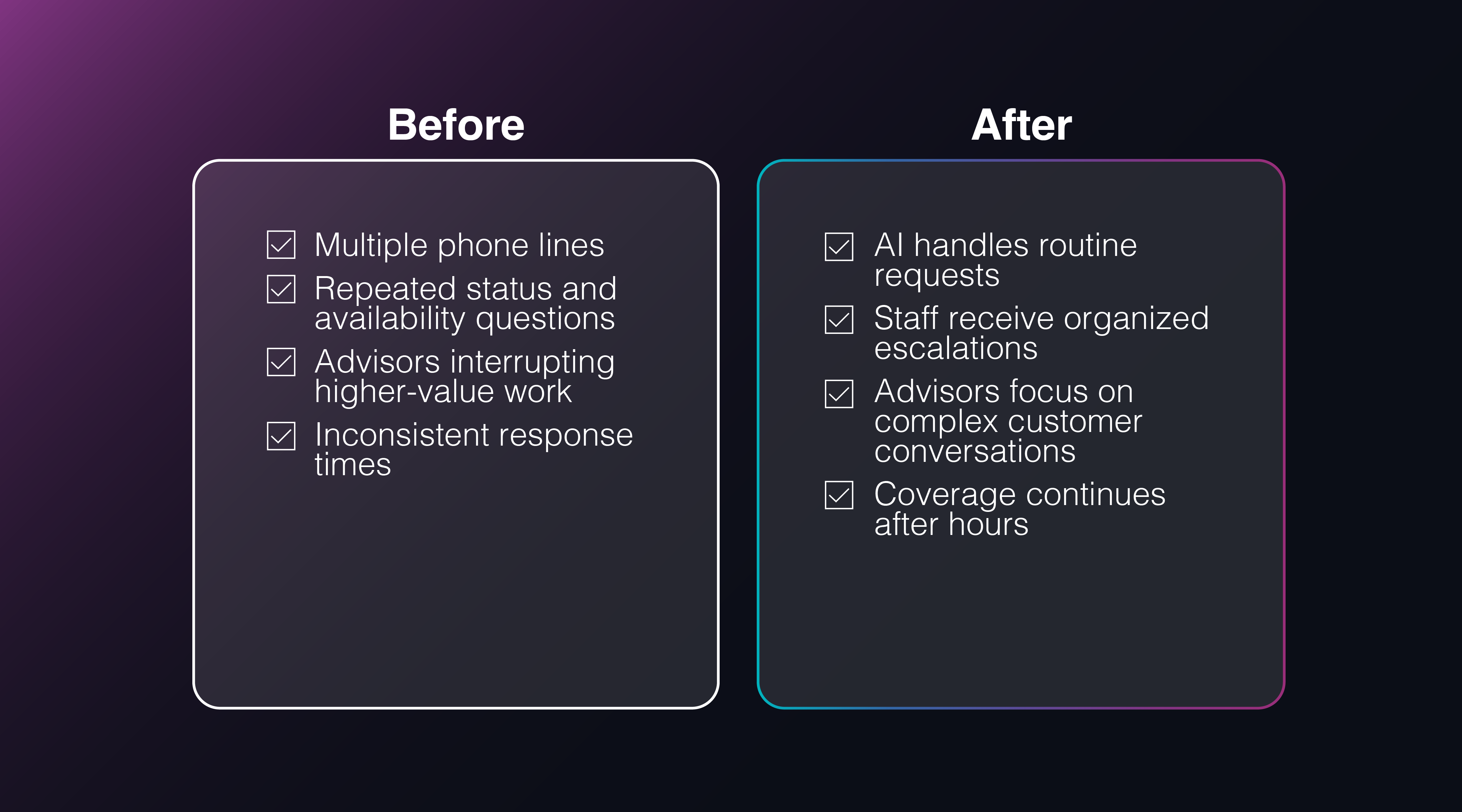
From Operational Overload to Intelligent Support
There are a few dimensions to that transformation:
Repair Speed and Turnaround: AI can triage incoming service requests, pre-populate estimates, flag likely parts needs before the car even arrives, and keep the shop's schedule tight instead of leaving bays idle, waiting on information that a human hasn't had time to gather.
Inventory and Parts Flow: Matching what's needed for upcoming repairs against what's on the shelf and what's arriving cuts down on the “we had to order that part” delays that frustrate customers and stretch turnaround times.
Customer Experience and Trust: Customers increasingly expect instant, accurate answers about pricing, availability, and status delivered the way they already communicate: text, chat, or a quick call that doesn't put them on hold. Delight, in this context, often just means not making someone wait.
Always-on Coverage: Perhaps most importantly, AI doesn't clock out. It can pick up the 9:00 p.m. tire question, the Sunday-morning “do you have this trim in stock,” inquiry, and the after-hours service request, without adding headcount.
Dealers are embracing AI in principle, but far fewer are putting it to work in practice. Although 60% of dealerships say they are exploring AI, just 15% have integrated it into the workflows and decisions that drive the business. That disconnect suggests the industry has been successful at testing AI, but less successful at operationalizing it in ways that create lasting value.
The Dealer Assist Agent Difference, At a Glance
Zooming in from the industry-wide picture to the tool itself, here's how DAA solves dealer pain points:
| Pain Point | Problem | How DAA Solves It |
|---|---|---|
| Leads go cold after hours | Inquiries outside of business hours get no response until the next business day; dealerships lose customers to faster competitors | Runs 24/7, responds instantly regardless of time of day |
| Staff can't be everywhere at once | Sales and service teams are stretched thin, high-value conversations get rushed | Absorbs repetitive, high-volume interactions; frees staff for complex conversations |
| Systems don't talk to each other | Reps juggle CRM, DMS, and inventory tools separately, causing delays and errors | Integrates directly with VinSolutions, Dealer Logix, vAuto, Cox DMS and many other systems for real-time answers |
| Inconsistent customer experience | Response quality varies by rep, mood, and day | Our customizable tool delivers the same accurate, on-brand response every time |
| Follow-up falls through the cracks | Leads get one response then go cold with no systematic nurture | Automates ongoing follow-up, keeps conversations alive |
| Round-the-clock staffing is costly | 24/7 human coverage is expensive or impossible to staff | Delivers 24/7 coverage without added headcount |
Not All AI Is Created Equal — Choosing the Right Partner is Critical
The AI space in automotive retail is crowded. New vendors show up every quarter promising bold transformation, and it's easy for dealership leadership to assume any AI solution will do. It won't.
Before committing to a platform, dealerships should look past the pitch and ask a few pointed questions.
Respect for Existing Systems of Record: The right AI solution doesn't ask dealers to adopt yet another platform, dashboard, or process. While many solutions can connect to a DMS or CRM, true value comes from adapting to the way a dealership already operates. AI should work within existing systems of record and established workflows, automating repetitive tasks and streamlining execution without forcing the team to change how they work day-to-day. The goal is simple: help staff become more productive and capture more revenue without giving them another system to manage.
Data Privacy and Security: How is customer data handled? Not every AI vendor treats this with the rigor it deserves. Some are focused primarily on growing revenue, but haven't built out the foundational privacy and security layers that protect a dealership's customer data.
Pricing that Reflects Real Capability: Aggressive, rock-bottom pricing can be a signal, not a bargain. A vendor undercutting the market on price may not have the infrastructure to scale reliably or the bench to deliver consistent service quality once you're live. The cheapest quote and the best long-term partner are not always the same vendor.
Customer Experience, Designed Deliberately: Not all “AI” is equal in practice. We've come across dealerships that experimented with off-the-shelf, open-source AI tools that technically “worked,” filtering and returning results based on customer input, but ultimately delivering a poor experience. One dealership had implemented exactly this kind of self-serve, open-source setup. Technically, they could say they had “added AI.” In practice, the experience was clunky enough that customers likely couldn't tell it apart from no automation at all, and worse, it did nothing to help that dealership compete against others doing this well. Claiming AI adoption and delivering a strong AI-powered experience are two very different things, and only one of them moves the needle.
Bottom line: picking the right partner – one with real experience implementing AI in auto and dealership environments, not just building it in a lab – is as important as the decision to adopt AI in the first place.
What We Saw When We Implemented This
When we began deploying AI solutions into dealership operations, we didn't start with the flashiest use case. We started with the most obviously broken one: after-hours coverage.
The pattern has been consistent across nearly every dealership we’ve worked with. A meaningful share of service and sales inquiries were arriving outside business hours – after the last advisor went home, before the first one arrived, or on weekends when staffing was thinnest. None of that demand was captured in any systematic way. It was pure leakage: real customers, with real intent, going unanswered.
By using AI to address that gap – picking up service requests and sales inquiries around the clock, answering the routine questions immediately, and routing anything that needed a human straight to the right person the next business day – dealerships didn’t just save labor costs. They recovered revenue and appointments that had previously evaporated overnight.
After-hours request capture became the proof point for a bigger thesis: AI's first job in a dealership isn't to replace people. It's to stop dealerships from losing customers to the clock.
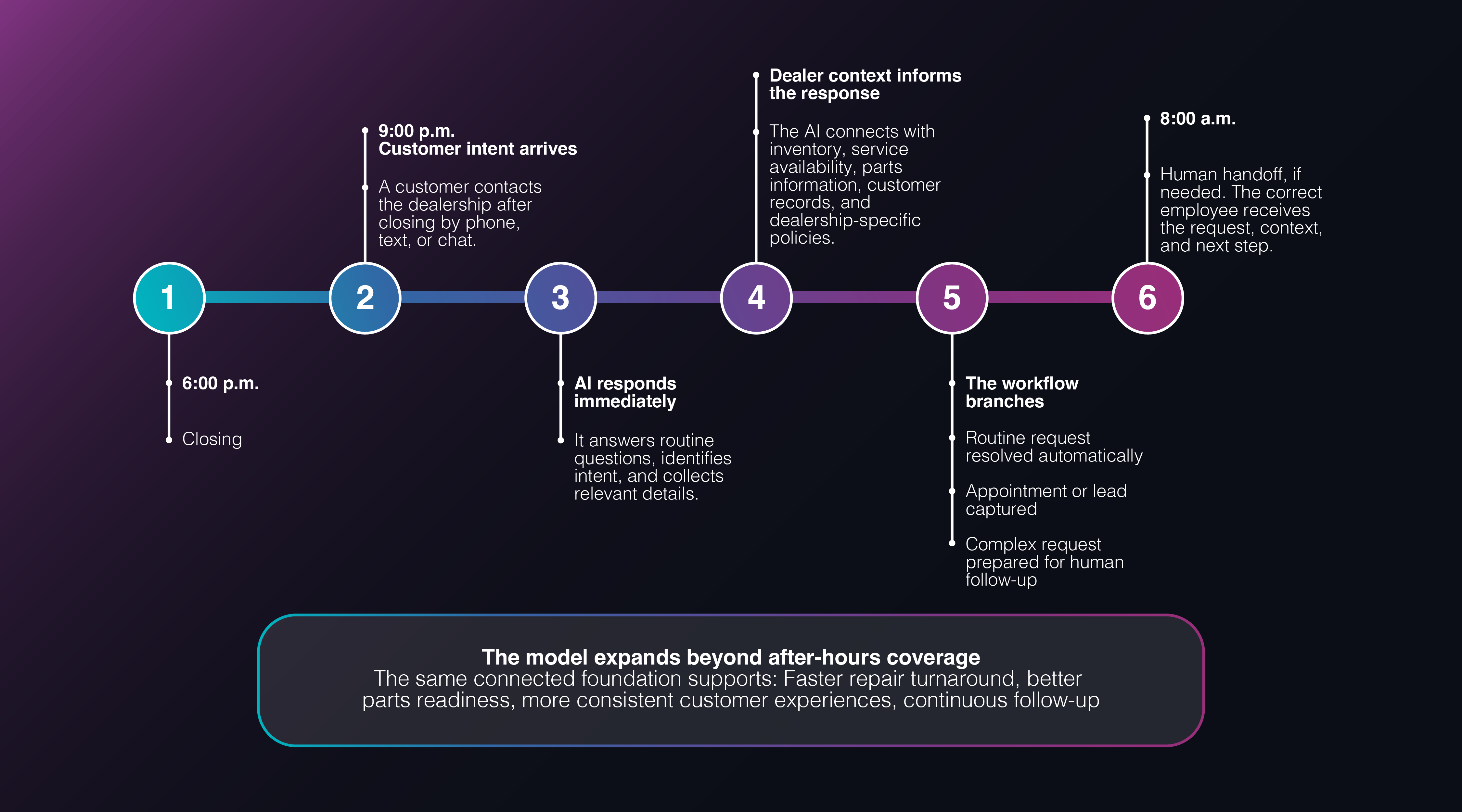
How DAA Keeps Customer Intent Moving After Hours
Coming Up in This Series
In the next part of this series, we'll go deeper into what customers want from AI interactions, where they welcome automation, where they still want a human, and how the best implementations blend the two. We'll also start unpacking specific implementation lessons: what worked, what didn't, and how to roll AI into a dealership without disrupting the team already working hard to keep the lights on.
If you’re interested in learning more about integrating AI into your dealership operations, please reach out or find the Cerence AI team at the Digital Dealer Conference (Booth #214) in Detroit, from September 22-23.
Stay tuned for Part 2.

.png)