From Vibe Coding to Vibe Design
A Q&A with Markus Funk, Director of User Experience
Cerence AI’s UX Design team works hands‑on with automakers and other enterprise customers to design conversational AI-powered user experiences. The team blends user research, conversational and interaction design, and deep domain expertise to translate advanced AI capabilities into intuitive, production-ready experiences.
As those AI capabilities accelerate, the way experiences are designed is changing. One emerging concept gaining traction is “vibe coding” - and with it, the birth of “vibe design.”
To explore what this shift means from a UX perspective, we spoke with Markus Funk, Director of User Experience at Cerence AI. In this Q&A, Markus shares how emerging AI‑driven workflows are accelerating creativity, reshaping iteration cycles, and changing how UX teams think about their role, while keeping people, fundamentals, and customer needs firmly at the center.
Q: Let’s start at the beginning. How do you think about “vibe design”?
Markus Funk:
We see vibe design primarily as a workflow shift.
At a high level, it means we can take a design challenge, feed it to AI, teach the system about our UX principles, components, and rules, and then let it explore solutions creatively within those boundaries. What is powerful is not that AI replaces design work, but that it helps quickly generate meaningful options and thought starters that follow our rules and conventions.
Experiences that used to take days to visualize can now take minutes. Of course, those outputs still need human judgment to become customer‑ and production-ready, but the speed of early exploration is fundamentally different. One of the interesting aspects is that we can also allow AI to break one or multiple of our design rules and constraints to immediately see the drawbacks and benefits of changing the rules, an exercise which would be very costly to explore without AI.
Q: What changed to make this possible now?
Markus:
Tooling is the biggest shift.
Right now, much of the attention is on vibe coding, especially as tools like Claude Code shake up how software is built. We are already seeing that expand into visual capabilities and design workflows with tools like Google’s Stitch gaining significant adoption in the design community.
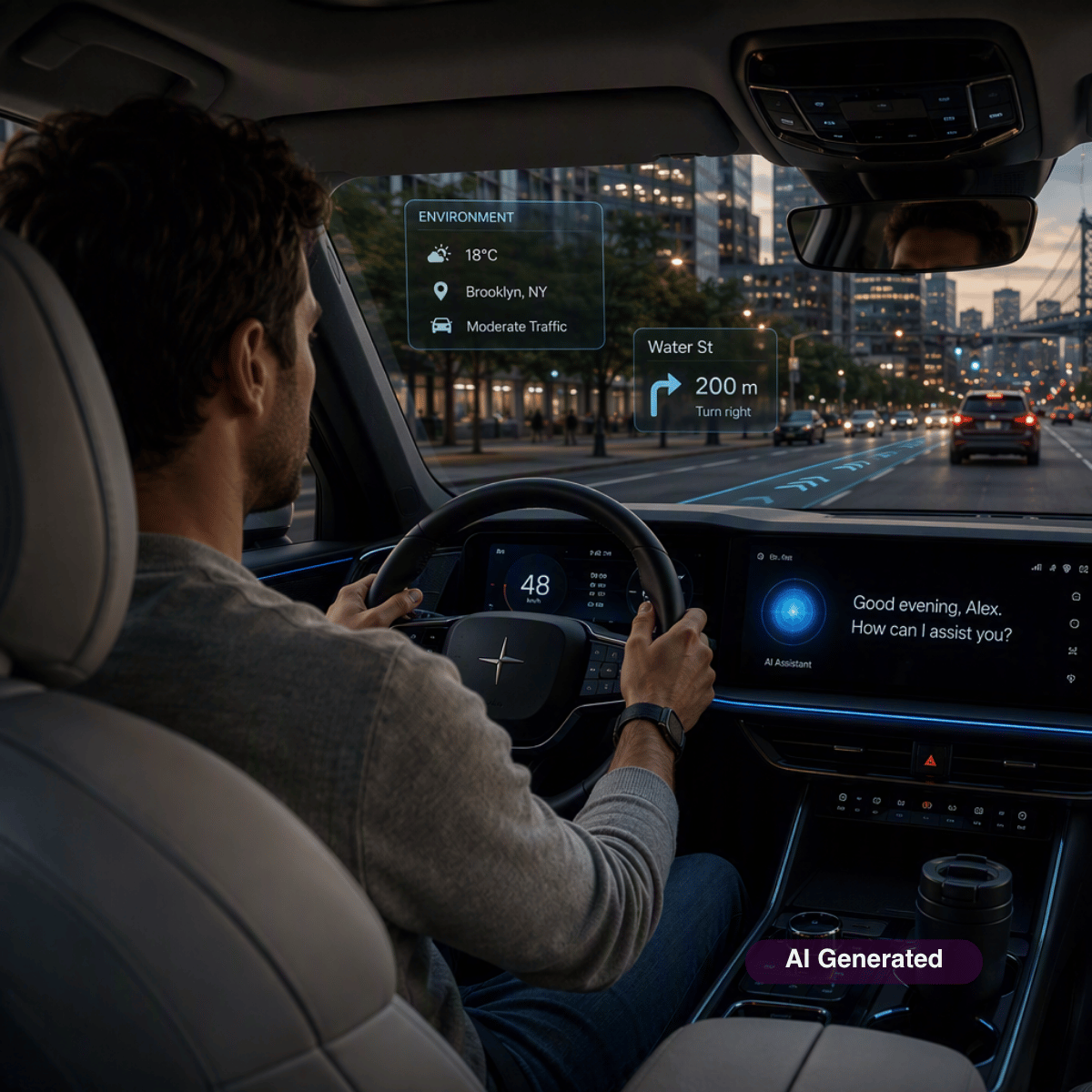
Prototyping is the main use case today. We can move from an idea to something visual far faster than before, which helps teams make decisions earlier and with more confidence. For example, in automotive, we can prototype graphical user interfaces that integrate with our voice technology without distracting drivers. Vibe design helps us explore options with different visual intensity so we can judge which elements support the query and which elements are unnecessary.
Over time, this will extend further, for example enabling prompts that move directly from an idea to a reference application or design concept. That kind of velocity changes how teams work.
Q: How does this differ from traditional UX workflows?
Markus:
The biggest difference is iteration speed.
Traditional UX workflows still rely on structured steps such as wireframes, reviews, and revisions, and those steps continue to matter. What vibe‑driven workflows change is how quickly we can get something tangible early on. That supports a strong test‑and‑learn mindset. While wrong decisions in the early design phases used to be very expensive, with vibe designing we can now easily pivot to an alternate scenario.
It is a significant boost for creativity. When it becomes easier to try something, teams are more willing to explore alternatives, compare approaches, and ask new questions instead of locking in too early.
Q: Where does the human fit into all of this?
Markus:
The human in the loop is essential. And I want to quote Jordan Wilson here that we not only need a human in the loop – we need an expert in the loop.
AI does not remove the need for UX fundamentals. You cannot create great interfaces without people who understand users, context, and design basics. A lot of the work is in teaching the system. That includes establishing domain knowledge, defining core components, and setting the rules that guide the output.
The vibe design tool will not turn somebody that has never designed before into a senior level designer. However, it will help senior level designers increase their output. In other words, the tooling accelerates expertise. It does not do the job for you in a single step.
Just like when teaching a new employee how to do new tasks, it is important to look at the chain of thought and see if the vibe design tool is making the correct assumptions and decisions. These tools need supervision to stay on track and learn how expert designers are working in our company.
Q: How do you see the role of UX evolving as vibe design matures?
Markus:
The role will definitely evolve. I think that clear communication, idea articulation, and structured thinking will become more and more important as we enter a world where AI truly becomes our co-worker.
Core hard skills still matter, but there is more focus on system behavior and on defining the frameworks that guide design. Curiosity becomes even more important, alongside a solid understanding of the basics.
We are looking for people who are curious, who understand the tools, and who also understand customer preferences well enough to shape ideas into great user experiences.
Q: How is this influencing how you think about designing user experiences?
Markus:
It’s hard to even imagine where we will be in a few months.
I’ve spent a lot of time experimenting with these tools. You can already move from idea to something tangible incredibly fast. That velocity is eye‑opening. It makes you realize that almost anything we can imagine, we can now prototype within a couple of hours.
For UX teams, that means less friction between ideas and execution, and more energy spent refining experiences.
Q: What separates good AI‑generated experiences from bad ones?
Markus:
The tooling does not magically produce great results on its own. It amplifies skill. People who care about craft, who understand their users, and who put real thought into what they create tend to get much better outcomes. Just like in every other medium, we will unfortunately also have to deal with AI design slop. Similar to text, images, and videos, you will be able to tell if somebody that used AI for design understood the craft or not.
You can tell when care and intention were involved. I am confident that the strongest designs will still reflect human judgment and taste.
Q: What is the big takeaway for UX teams watching this space?
Markus:
This is about efficiency and momentum, not shortcuts.
Vibe design reduces friction in the creative process. Less energy is lost between intent and execution. That allows teams to move faster, explore more freely, and adapt as expectations continue to change.
We are still early, and we are realistic about where things stand today. But the direction is clear. Workflows are changing, iteration is accelerating, and UX teams that stay curious while remaining grounded in fundamentals will be best positioned for what comes next.
Markus Funk
Dr. Markus Funk is leading the UX Design team at Cerence AI. He holds a PhD in Human-Computer Interaction that he acquired during his time at the University of Stuttgart and the MIT Media Lab. Markus is passionate about designing meaningful, user‑centered experiences powered by AI.